
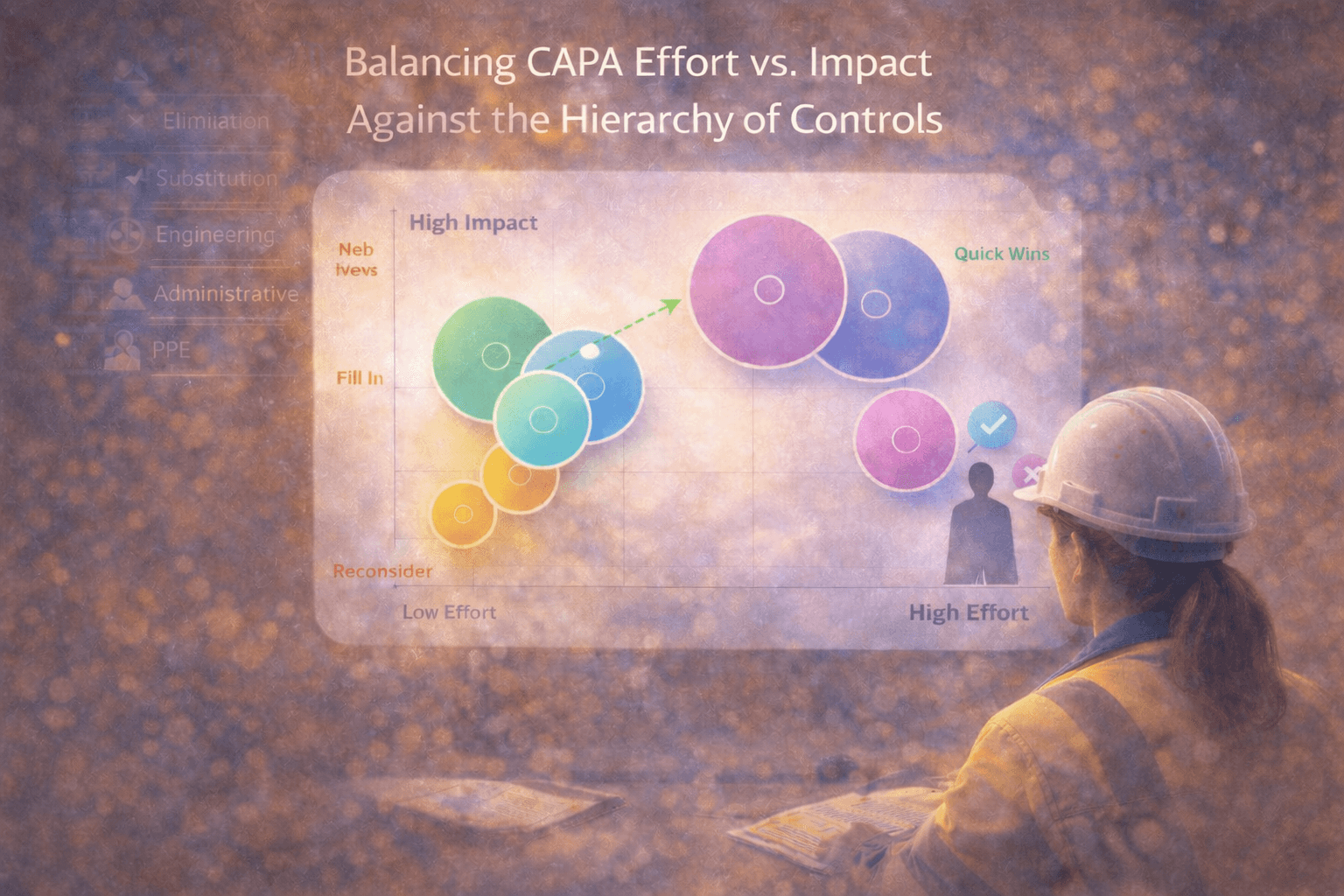
The hierarchy of controls is one of the most widely taught concepts in EHS. Eliminate the hazard. If you cannot, substitute. If you cannot, engineer it out. Then administrative controls. PPE last.
Everyone agrees with the principle. The challenge is execution.
In real operations, CAPA decisions are constrained by downtime windows, engineering bandwidth, contractor turnover, procurement lead times, budget cycles, and the simple fact that you have to keep operations running. That is why many investigations end in training, reminders, and procedure updates. They are fast. They are easy. They are also often fragile.
This post lays out a five-step practical framework to choose CAPAs that still respects the hierarchy, but also makes tradeoffs explicit by assessing each CAPA option on impact, effort, and confidence, then presenting a balanced bundle of controls for human decision makers.
Step 1: Define the risk in terms of failure modes, not the incident label
Most teams are highly proficient in this step. They don't start a CAPA thinking from “forklift near miss” or “hand injury.” Those labels describe outcomes, not the underlying mechanism.
Instead, they define:
- hazard and energy source
- exposure pathway
- failure mode(s) that made exposure possible
- critical controls that should have prevented escalation
This turns one incident into a prevention opportunity for a whole class of events.
It also aligns with how regulators and guidance documents treat control selection: you are managing risk, not just closing a case. OSHA’s hazard prevention guidance and hierarchy worksheet are practical reminders that control selection is a deliberate process and often uses a combination of controls. (osha.gov) (osha.gov)
Step 2: Build a “control menu” before choosing
Before you debate feasibility, force the team to create options across the hierarchy. This prevents the default-to-training trap.
A practical rule:
- Require at least one option in each bucket where plausible:
This is consistent with how many authoritative sources frame the hierarchy: start at the top, but expect real programs to layer controls, including interim measures while longer-term solutions are developed. (osha.gov) (cdc.gov)
A useful mental model from applied safety writing is: create the menu first, then decide. (thesaferchoice.co.uk)
Step 3: Assess each CAPA option on two axes: Impact and Effort
This is where the hierarchy becomes operational.
Instead of saying “engineering controls are better,” quantify:
- how much risk reduction you expect, and
- what it will take to implement and sustain.
Impact score (1–5, or simply High/Medium/Low)
Impact should mean expected reduction in risk, not “how good it sounds.”
Score impact on:
- exposure reduction: does it reduce frequency, duration, proximity?
- reliability: how behavior-dependent is it?
- coverage: does it protect across scenarios or only one?
- barrier strength: does it add or strengthen a critical control?
- residual risk: what remains afterward?
Suggested anchors:
- 5: eliminates exposure or adds a robust engineered barrier with high reliability and broad coverage
- 3: reduces risk but relies on compliance, supervision, or perfect execution
- 1: minimal effect or mainly informational
This aligns with the core rationale behind the hierarchy: higher-order controls reduce reliance on perfect human behavior. (cdc.gov)
Effort score (1–5, or simply High/Medium/Low)
Effort is more than cost. It includes time, disruption, and organizational friction.
Score effort on:
- lead time: days vs weeks vs months
- operational disruption: downtime windows, throughput impacts
- engineering complexity: design, approvals, commissioning
- change management burden: training, contractor adoption, supervision load
- sustainment burden: ongoing inspections, calibration, audits, consumables
Suggested anchors:
- 5: capex, long-lead, shutdown-dependent, complex change
- 3: moderate effort and coordination
- 1: quick to implement with minimal disruption
This fits well with “reasonably practicable” thinking: real organizations weigh risk reduction against time, trouble, and cost. UK HSE’s framing is explicitly about balancing the level of risk against the sacrifice required to control it. (hse.gov.uk)
Step 4: Add a third dimension: Confidence (important for AI-output)
If you want honest decisions, you need a way to represent uncertainty.
Use a confidence score (1–3) based on:
- evidence quality supporting the causal link
- proven effectiveness in similar contexts
- clarity of implementation and verification plan
This stops teams from over-claiming certainty about CAPA effectiveness.
Step 5: Calculate a priority score, then choose a balanced portfolio
A simple formula that is easy to explain:
CAPA Priority = (Impact × Confidence) / Effort
This produces an initial ranking, but do not treat it as a single winner. The best outcome is usually a bundle:
- a long-term high-impact engineered control (even if effort is high)
- interim controls to reduce exposure quickly while engineering work is underway
- verification actions to ensure adoption and effectiveness
This is consistent with practical regulator guidance that recognizes interim controls while longer-term solutions are planned and implemented. (osha.gov)
Example: Mobile equipment and pedestrian interface
Failure mode: pedestrian exposure in travel lanes and blind spots
Control menu options:
- elimination/substitution: remove pedestrian access to zone, redesign material flow route
- engineering: physical separation, barriers, controlled crossings, one-way systems
- admin: traffic management plan, speed limits, right-of-way rules
- detection: proximity alerts, cameras, spotters
- PPE: high-vis
Illustrative scoring:
| CAPA option | Impact (1–5) | Effort (1–5) | Confidence (1–3) | Score |
|---|---|---|---|---|
| Physical separation and controlled crossings | 5 | 4 | 3 | 3.75 |
| Proximity detection system | 4 | 3 | 2 | 2.67 |
| Traffic rules + speed policy refresh | 3 | 2 | 2 | 3.00 |
| Training refresh only | 2 | 1 | 2 | 4.00 |
The math highlights a reality: low-effort actions can look “high priority” because effort is in the denominator. That is why you need governance rules:
- For high-risk failure modes, training can be supportive or interim, but should not be the primary control.
This is also why many SIF prevention guides emphasize selecting CAPAs using the hierarchy and prioritizing stronger controls. (ingaa.org)
What a good CAPA decision output typically looks like
A strong CAPA output is not a single action. It is a structured decision package:
- Top 3 to 6 options ranked by impact, effort, and confidence
- A recommended bundle:
- A rationale tied back to failure modes and critical controls
This is what allows leadership to make informed decisions.
Where AI-powered CAPA tools transform the process
The hard part of running this consistently is not the math. It is doing the surrounding work at scale:
- generating a real control menu across the hierarchy instead of defaulting to admin actions
- estimating impact based on similar historical cases and outcomes
- estimating effort based on prior implementations, lead times, and dependencies
- keeping scoring consistent across sites and investigators
- mapping different narratives back to the same failure modes and critical controls
Tools in the AI-powered RCA and CAPA category, especially those built around a safety knowledge graph like Haven’s, can help by:
- suggesting control options across the hierarchy based on the failure mode
- predicting likely impact using patterns from similar events and controls
- estimating effort using prior implementations and required dependencies
- maintaining consistent taxonomy for failure modes, controls, assets, and precursors across the enterprise
- presenting ranked options to humans with the supporting evidence so they can make a balanced decision
The goal is not “AI decides, but AI provides well-reasoned options and the humans expert decide.
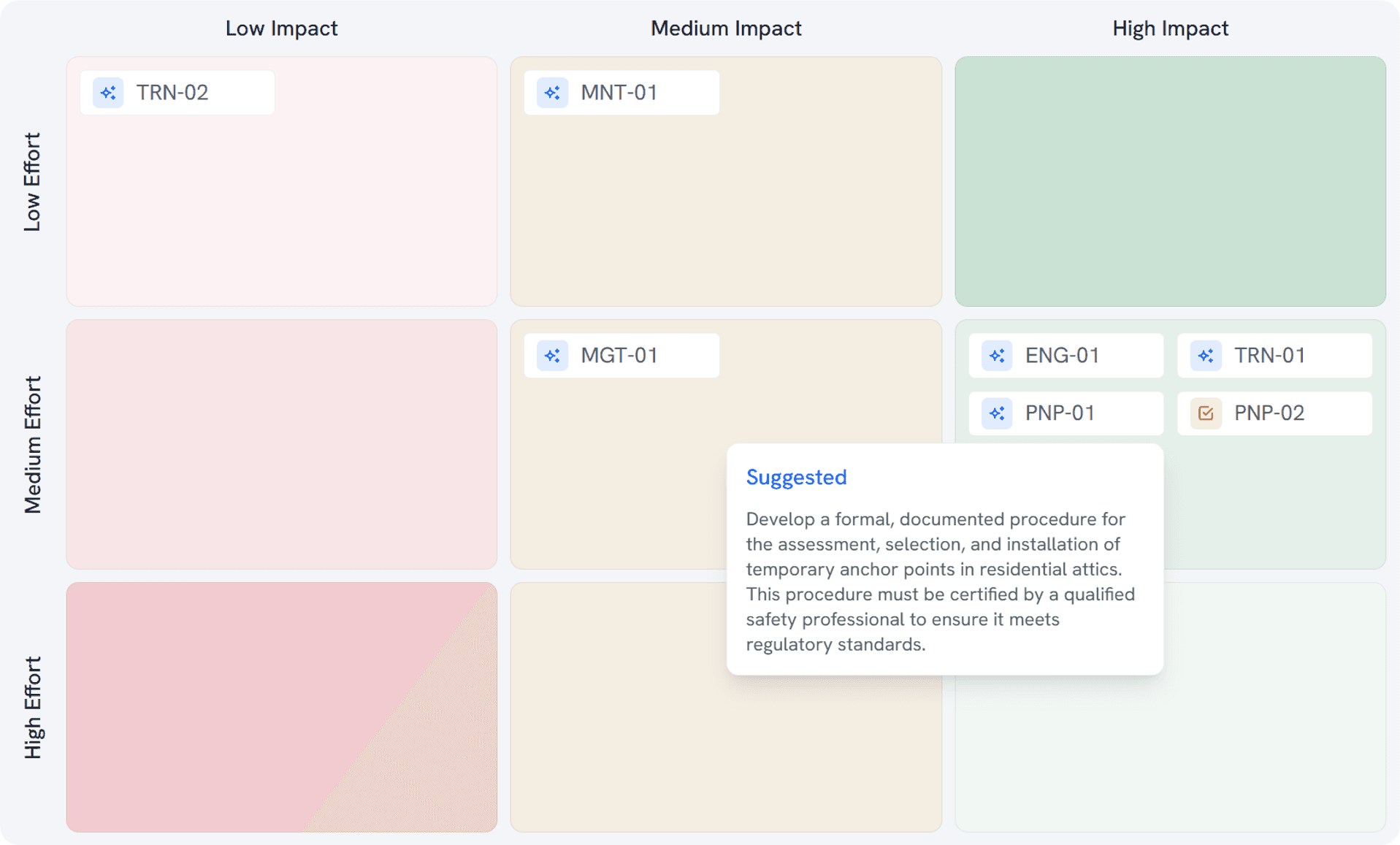
Below is a sample AI recommendation from HavenEDGE CAPA module, which is powered by Haven's Industry Knowledge Graph.
References
- NIOSH (CDC). “Hierarchy of Controls.” (cdc.gov)
- OSHA. “Identifying Hazard Control Options: The Hierarchy of Controls” (worksheet PDF). (osha.gov)
- OSHA. “Hazard Prevention and Control.” (osha.gov)
- UK HSE. “Risk assessment: Steps needed to manage risk” (reasonably practicable balancing). (hse.gov.uk)
- Safe Work Australia. “Model Code of Practice: How to manage work health and safety risks” (Nov 2024). (safeworkaustralia.gov.au)
- INGAA. “Guidance for Serious Injury and Fatality Prevention” (rev. 11/18/2024). (ingaa.org)
- The Safer Choice. “Creating a menu of controls (don’t choose yet).” (thesaferchoice.co.uk)