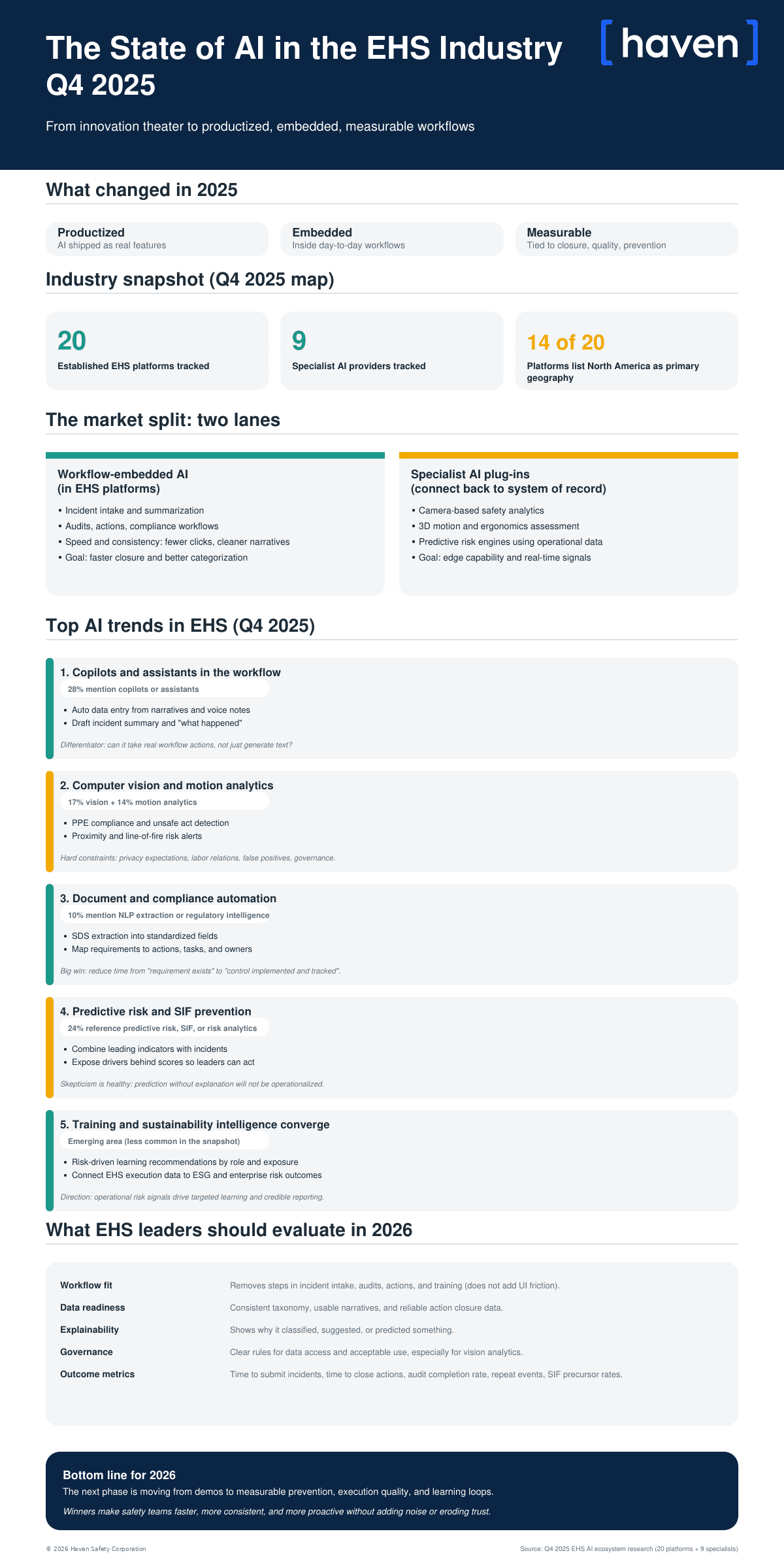

The State of AI in the EHS Industry - Q4 2025
AI in Environment, Health, and Safety (EHS) has moved past the “innovation theater” phase. In 2025, it became productized, embedded, and increasingly measurable. The most important shift is not that AI exists in EHS software, it is where it shows up in day to day workflows: incident entry, audits, corrective actions, training, risk reviews, and frontline observations.
We researched the industry in depth and developed Q4 2025 industry map tracking 20 established EHS platforms plus 9 specialist AI providers. Our analysis shows a clear pattern: mainstream platforms are racing to embed AI into core workflows,
While specialists push the edge in visual intelligence, motion analytics, and predictive risk. The customer base for the major platforms in this snapshot skews North America first (14 of 20 list it as their primary geography), with Europe next, and a smaller presence elsewhere. Heavy industry dominates the “home turf” use cases, especially industrial manufacturing and energy adjacent operations, where incident volume, hazard complexity, and regulatory burden make automation and prediction worth paying for.
Below are the biggest trends shaping what “AI in EHS” actually means right now, with examples of the types of products being introduced across the ecosystem.
Market and ecosystem update: what changed in 2025
Across analyst coverage and vendor roadmaps, AI is now a default expectation in EHS buying conversations. The market has split into two lanes:
- Workflow embedded AI in EHS platformsThese are AI features that live inside incident management, audits, action tracking, and compliance modules. The value proposition is speed and consistency: fewer clicks, cleaner narratives, better categorization, and faster closure.
- Specialist AI systems that plug inThese include camera based safety analytics, 3D motion and ergonomics assessment, and predictive risk engines that ingest operational data. They typically integrate back into the “system of record” rather than replacing it.
Practically, adoption will hinge on trust, explainability, and whether the models generalize beyond the platform and industry segments it was trained on.
Trend 1: AI copilots and assistants move into the workflow
The most common AI product pattern in the map is the copilot: a natural language assistant embedded inside EHS screens.
In the tracked AI capabilities list, about 28% explicitly position as copilots or assistants. The functional pattern is consistent:
- Automated data entry from messy narratives, voice notes, or short field inputs
- Incident summarization and “what happened” drafting
- Suggested classifications like event type, hazard category, contributing factors
- Draft corrective actions mapped to common control frameworks
- Natural language Q&A over policies, procedures, and internal knowledge bases (often implemented with retrieval over documents, sometimes called RAG)
The best versions feel like a “power user in a box.” The weakest versions feel like a chat window stapled to a form. The differentiator is whether the assistant can take real workflow actions, not just generate text.
Trend 2: Computer vision and motion analytics expand from PPE to prevention
Visual intelligence is the second big product category. In the sample, about 17% explicitly reference computer vision or image based hazard recognition, and another 14% reference motion capture or 3D motion analytics.
These solutions are being positioned for:
- PPE compliance and unsafe act detection (hard hats, eyewear, restricted zones)
- Proximity and line of fire risk (people, vehicles, pinch points)
- Near miss detection through pattern recognition in video streams
- Ergonomic strain analysis using 3D motion capture and motion analytics, often framed as proactive MSD prevention
This is where EHS AI becomes operationally “real time,” but it also introduces the hardest non technical constraints: privacy expectations, labor relations, camera placement, false positive management, and the need for clear governance on how alerts are used.
Trend 3: Document and compliance automation goes from “search” to “structured action”
Another clear theme is turning unstructured compliance inputs into structured, auditable work. Roughly 10% of tracked capabilities explicitly call out NLP extraction or regulatory intelligence.
Common product shapes include:
- Safety Data Sheet (SDS) extraction into standardized fields and exposure controls
- Automated mapping from requirements to actions, tasks, and owners
- Regulatory change monitoring translated into impacts on internal programs
- Permit and procedure parsing to reduce manual review overhead
The biggest win here is not a prettier document summary. It is reducing the time between “a requirement exists” and “a control is implemented and tracked.”
Trend 4: Predictive risk and SIF prevention gets more specific
Predictive analytics is no longer marketed as generic “risk scoring.” It is becoming more targeted, with language like SIF precursors, potential SIF insights, and control effectiveness.
In the tracked set, about 24% explicitly reference predictive risk, SIF, or risk analytics. The most credible systems share a few traits:
- They combine lagging signals (incidents) with leading indicators (observations, exposure hours, equipment state, work type, location risk, control status).
- They expose drivers behind the score so an EHS leader can act, not just stare at a number.
- They produce a workflow output: prioritized reviews, targeted audits, control recommendations, or escalation triggers.
This is also where skepticism is healthiest. Prediction that cannot be explained will not be operationalized. And prediction that only works inside one closed dataset can struggle to generalize across sites, geographies, and work types.
Trend 5: Training and sustainability intelligence start to converge with EHS AI
While less common in the spreadsheet snapshot, two adjacent areas are gaining momentum:
- Training intelligence that recommends content, adapts to roles, and supports knowledge reinforcement based on observed risk patterns
- Sustainability and enterprise risk analytics that connect EHS performance to broader operational and ESG outcomes
The interesting direction is convergence: using operational risk signals to drive targeted learning, and using EHS execution data to improve sustainability reporting credibility.
Where does Haven Safety AI fit?
To address a persistent gap in how AI is applied to incident investigations specifically, Haven Safety AI was built to focus less on generic summarization and more on investigation quality, consistency, and defensibility.
At its core is a first-of-its-kind industry specific EHS knowledge graph that connects hazards, energy sources, tasks, controls, causal factors, and outcomes, so the system can reason in the same structure investigators use rather than treating every narrative as free text. Haven also uses multi-modal reasoning to synthesize evidence across formats such as witness statements, incident notes, photos, documents, and other available signals, then reconcile what is known, what is missing, and what conflicts.
The result is support for the investigator that is oriented around conclusions you can stand behind: clearer event timelines, more disciplined causal analysis, and corrective actions that map back to control gaps instead of generic recommendations. Just as important, the design emphasizes traceability so outputs can be tied back to the underlying evidence and reviewed by humans before anything is finalized, which is critical in high consequence EHS investigations.
What this means for EHS leaders in 2026
If you are evaluating AI in EHS, the best question is not “does it have AI?” It is “what repetitive, high friction work will this remove, and what decisions will it improve?”
A practical evaluation checklist:
- Workflow fit: Does it reduce steps in incident intake, audits, actions, and training, or does it add another UI?
- Data readiness: Do you have consistent taxonomy, decent narratives, and clean action closure data?
- Explainability: Can the system show why it classified, suggested, or predicted something?
- Governance: Who can use it, what data it can access, and how outputs can and cannot be used (especially for vision analytics).
- Outcome metrics: Time to submit incidents, time to close actions, audit completion rate, reduction in repeat events, changes in SIF precursor rates.
The bottom line
To sum up 2025, AI is a hot topic as expected, with these trends dominating the discussion:
- AI copilots and assistants
- Computer vision and motion analytics
- Document and compliance automation
- Predictive risk and SIF prevention
- Training and sustainability intelligence
The next phase is the hard part: moving from impressive demos to measurable improvements in prevention, execution quality, and learning loops. The winners will be the solutions that make safety teams faster, more consistent, and more proactive, without adding noise or eroding trust.